

Every year, third-year Economics undergraduates who take the module “Government, Welfare and Policy” design a poster on which they present their research into topical public policies – local, national, and international – from an economic viewpoint, minus the economics jargon. The students are tasked with identifying a current area of public policy debate, using economic analysis to investigate the topic, and presenting their findings in an attractive and informative public poster.
The students work in groups over several weeks, and their efforts usually culminate in a public event in The Forum in the city centre of Norwich. This year, the coronavirus pandemic once again forced the event online. The following blog article offers a wider public a chance to see some of the posters. The students themselves wrote the brief explanations for their posters and choose whether to submit them for the public blog.
We hope you find our students’ work interesting!
Poster A: Sex Trafficking in Nepal
By Iliana Sylikiotou, Alexandra-Maria Seizani Dimitriadi, Amina Salama & Kirty Gurung
The motivation of our poster came from the increased advocacy of women’s rights that have occurred in 2021, especially concerning sexual violence. As four females looking into policy, we immediately knew we wanted to base our poster on something we could firstly relate to, and secondly be passionate about: women’s rights. After researching a few different topics, we continued to come across articles covering sex trafficking. We educated ourselves on how the Covid-19 pandemic has allowed the trafficking industry to grow tremendously. Traffickers have become more innovative as they delve into cybersex and victims become more vulnerable, as their financial situation deteriorates. 62% of trafficking in the world happens in the Asia-pacific region due to reasons such as cultural norms, poverty, inequality, and high unemployment rates. After discovering the controversial travel ban policy proposed by Nepal’s government, we decided this to be an interesting basis for our policy analysis as it is something that we felt was a clear violation of women’s rights. We made the design of our poster imitate a picket (protest) sign, to relate to the human rights marches and women’s protests that have been ongoing in Nepal since the policy proposal.

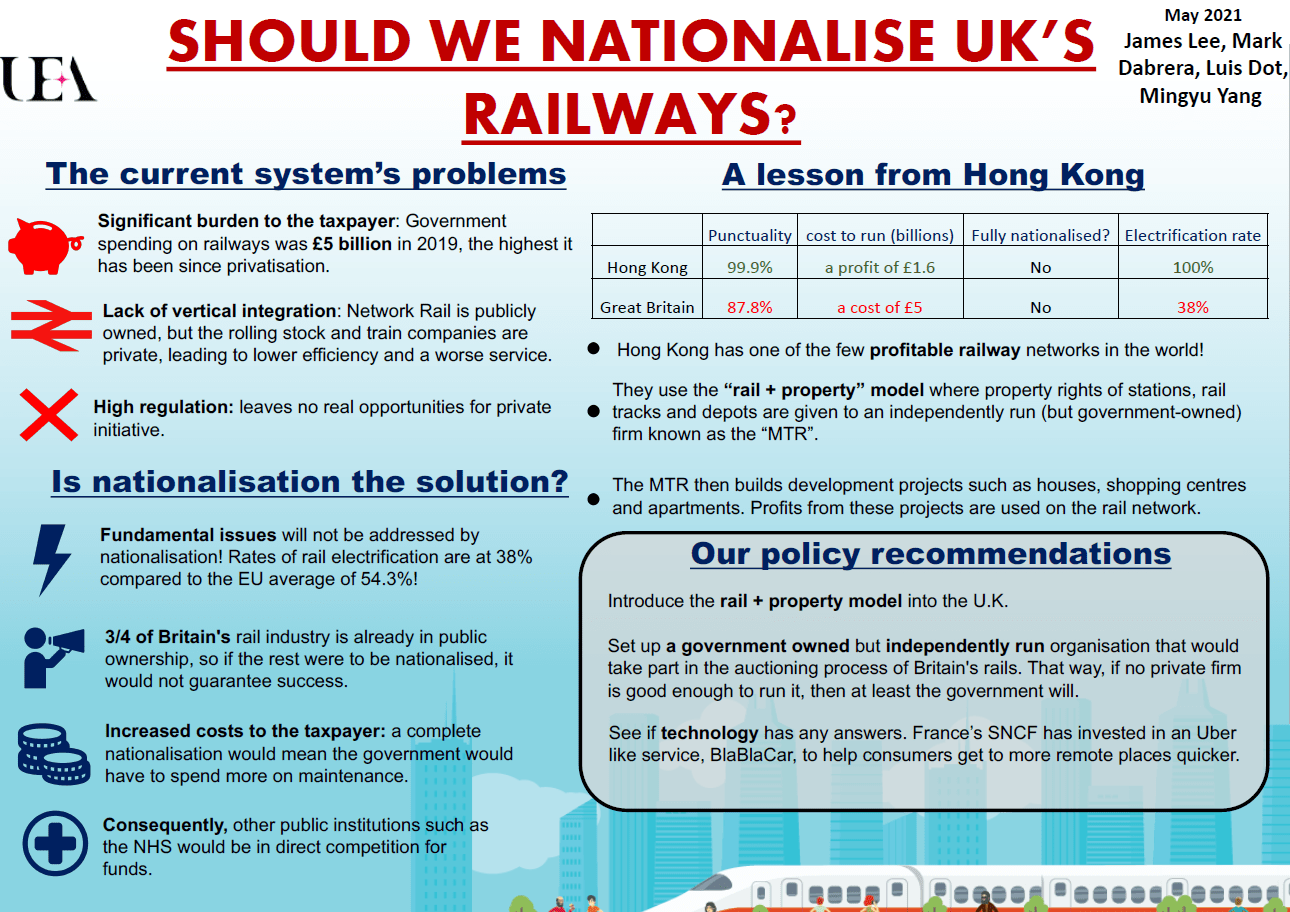
Poster B: Should we nationalise UK’s railways?
By James Lee, Luis Dot, Mark Dabrera & Mingyu Yang
For our poster, we criticized the current system of the UK’s railways and ask whether we should nationalize it. In the current system, the government’s rail spending is putting a significant burden on taxpayers, shows a lack of vertical integration, and high regulation which means private initiative is dampened. However, the nationalization of railways is not guaranteed to fix all the fundamental problems. Rates of rail electrification are one of the lowest in Europe even though the rails are publicly owned. We looked to Hong-Kong as they are one of the few rail networks which generate a profit for the government. We created a table with various sources to compare the two systems. Hong Kong uses the “rail + property” model where property rights of stations, rail track and depots are given to an independently run, but government-owned firm known as the “MTR”. MTR then uses its profits to not only invest in Hong-Kong’s rail network but other infrastructure projects. We then propose that the U.K also implements the “rail+ property” model as well the implementation of technology like we see with France’s SNCF and blah blah car.
Poster C: The Government’s Failure to Provide Affordable Housing
By Ieva Kalnina, Pierre Bruton, Owen Shackleton, Ollie Carlile
The poster focuses on the failure of the housing market in the UK to provide affordable housing for the low-income population. There are clear issues with the supply of social housing, with 1.1 million people on the waiting list and only 6287 more homes provided in 2018. We have looked at the policies put in place by the government to tackle these issues, in particular, Help to Buy – which is a demand side policy – and social housing allocation – which is a supply side policy. Whilst both these schemes make some steps in the right direction, Help to Buy is not well targeted towards the low-income population, with only 1 in 5 participants of the scheme having a lower-than-average income. Social housing allocation systems, on the other hand, struggle to find a balance between efficiency and quality of allocation. Looking at systems like Vienna, and the work of housing/homelessness charity Shelter it is clear that a combination of supply and demand side solutions is required to address the failures of the housing market. Moving forward, we have proposed first steps that can be taken in order to improve the existing policies in the UK. More needs to be done now to provide affordable housing.

Poster D: Long-Term Care
By Robert Watson, Joe Milligan, Enti Zhang & Ryan Mcmanus
Long-term Care (LTC) involves the provision of aid for basic living activities, for those considered incapable of self-care to an acceptable level. The patients in this context can include children and working-age adults with disabilities, however the majority of LTC patients are elderly, especially those with dementia. LTC is currently funded by the patient’s assets, unless the total value of these assets is below £14,250. And for those with assets above £23,250, no government support is provided. The poster examines the current approach to LTC funding in the UK and the issues involved, the case for and against reform, potential solutions and the alternate German System. We concluded that potentially a more wide-reaching public funding system, funded by employer and employee contribution, and hypothecated progressive tax for those who are uninsured, could close the growing gaps in LTC funding. The system should encourage contributions and only provide help (similar to a welfare payment) to those in need. Private out-of-pocket expenditure and private insurance would still be available for people to use.

Poster E: Lockdown or Freedom?
By Mohammad Abidi, Craig Wood, Samuel Pitch & Oliver Rees
The poster begins as we outline the main arguments for and against lockdown, as a UK-Brazilian comparison, followed by an economic comparison. This is because the UK used lockdown as a policy to combat COVID-19 and Brazil did not enter a single lockdown. The debate on lockdown has typically been about lives vs livelihoods. Are the lives saved from lockdown worth the livelihoods lost? This is a purely subjective and ethical question. Our poster looks at lockdown from a different angle. Therefore, we investigate if lockdown did reduce the spread of COVID-19, which would inevitably save lives. The graph shows the UK-Brazilian comparison of the COVID-19 reproduction rate, known as the r number. The r number is a measure of how easily COVID-19 is spreading at that time. A backwards looking scientific estimation based on relevant data. The findings from the data comparison show that whilst UK lockdowns caused a decrease in the r number, the easing of lockdown caused an increase above the Brazilian rate. This questions whether lockdown did save lives as the act of easing lockdown may have caused a higher spread of COVID-19 than if there was no lockdown at all. The design of the poster adopted a similar colour theme to the government COVID-19 posters because it is topical and eye catching.
