By Ms Huyue Mo – student on BSc International Finance FYE predicted to graduate with a First-degree classification.
Huyue holds an offer from University of St Andrews to study for a postgraduate degree.
Next time you fill up your car or pay an energy bill, know that you’re part of a story that’s about to change forever. The company behind that fuel – BP – one of the world’s largest oil giants is quietly racing to reinvent itself, because the world might not need it for much longer. For a company built on oil and gas, that question is an existential one!
Three storms hitting BP at once
To understand what BP is up against, picture three pressures arriving simultaneously The first is geopolitical turbulence. The war in Ukraine forced BP to abandon its 20% stake in Russian oil giant Rosneft almost overnight, crystallizing a £24 billion loss. Beyond Russia, conflicts in the Middle East and rising US-China tensions are making it harder and riskier for any multinational to operate in certain parts of the world.
Figure 1: How geopolitical fragmentation affects the energy system

Source: BP Energy Outlook, 2025
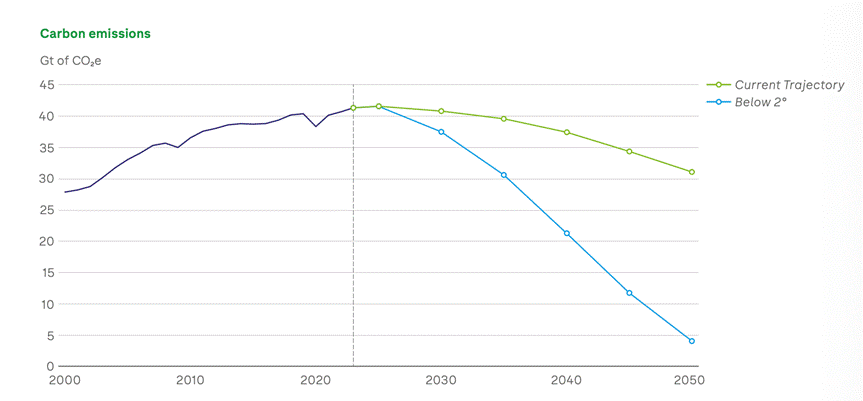
The second is the energy transition. Climate policy is tightening, as governments use carbon pricing, clean-energy subsidies and transition targets to push companies away from high-carbon investment. Energy forecasters widely expect global oil demand growth to slow dramatically this decade, with some projecting a peak before the mid-2030s. Under ambitious climate scenarios designed to keep global warming below 2°C, carbon emissions would need to fall sharply by 2050. Figure 2 shows just how large the gap is between BP’s current trajectory and a faster transition pathway.
Figure 2: Carbon emissions: current trajectory vs Below 2°C scenario.
Source: BP Energy Outlook, 2025
The third is ESG and investor pressure. It’s not just environmentalists putting pressure on BP. Some of the world’s biggest investors are now voting against oil companies that don’t have a serious plan to go green. For BP, that means higher borrowing costs and unhappy shareholders.
Why some countries are now too costly to stay in
Drilling for oil isn’t just a technical challenge; it’s a political one. Governments in unstable regions have learned they can rewrite the rules mid-game: seizing assets, tearing up contracts, demanding a bigger cut. When that happens, leaving early is almost always cheaper than being forced out later. BP learned that the hard way in Russia.
Why green investment is necessary but risky
Governments are pouring money in. The US Inflation Reduction Act alone committed $369 billion to clean energy. The numbers in Figure 3 show how dramatically road transport could shift: under a fast transition, electric vehicles could account for over 80% of kilometers driven in Europe and China by 2050.
Figure 3: Oil demand in road transport and the rising share of electric vehicles

Source: BP Energy Outlook, 2025
But green investment carries real risks. Building a wind farm or hydrogen plant is genuinely harder than it sounds, and cost overruns have already hit BP’s projects. The gap between a business plan and a working power plant can be enormous.
The “stranded asset” problem
Perhaps the most striking concept in BP’s predicament is the idea of a stranded asset. Imagine spending billions drilling for oil in a remote region, and by the time you extract it, nobody wants it. Carbon taxes have made it uncompetitive, demand has collapsed, and that investment never pays back. That is what economists call a stranded asset, and it is the quiet threat sitting on BP’s balance sheet right now. Think of it like buying a petrol car the year before electric vehicles took over, the asset is real, but suddenly nobody wants it.
BP’s dual strategy, greening up while cutting loose the riskiest parts of its portfolio, is not guaranteed to succeed. But the strategic logic is sound. For BP, the energy transition is not simply an environmental issue. It is a question of survival, capital discipline and political risk management. The winners will not be the companies that move fastest, but those that know which old assets to leave behind and which new technologies to bet on. The clock is ticking.